

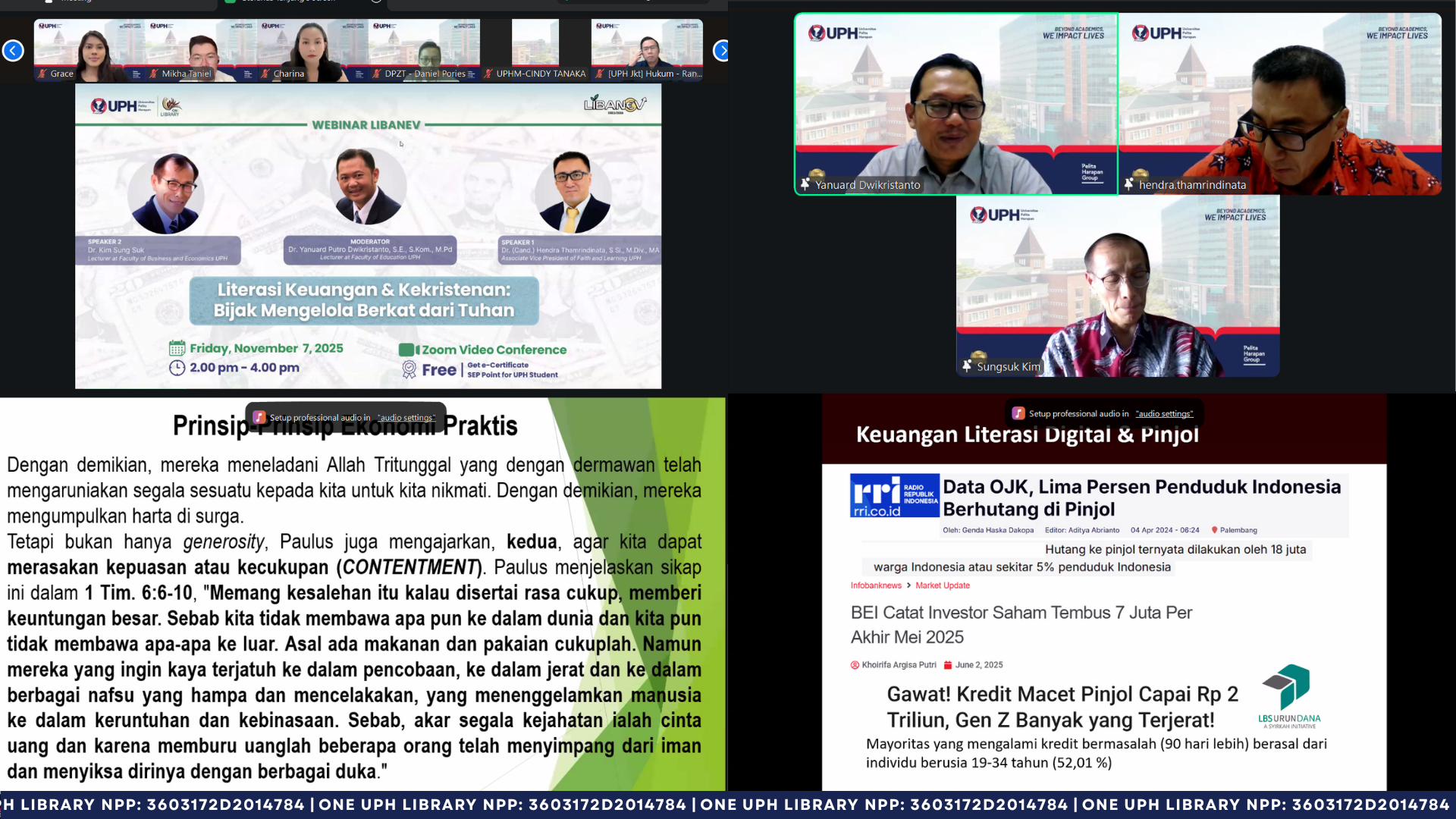
Libanev 2025/2026 officially commenced on Friday, November 7, 2025, carrying the central theme of financial literacy. The opening event featured a webinar titled “Literasi Keuangan dan Kekristenan: Bijak Mengelola Berkat dari Tuhan” This session was held amid growing concern over the nation’s low level of financial literacy, as well as the rising issues of debt, online loans, excessive spending, and financial instability within society and moderated by Dr. Yanuard Putro Dwikristanto, S.E., S.Kom., M.Pd in this whole webinar session.
The first presentation was delivered by Dr. (Cand.) Hendra Thamrindinata, S.Si., M.Div., M.A., Associate Vice President of Faith and Learning at Universitas Pelita Harapan. In his session, “A Reformed Perspective on Finance,” Dr. Hendra Thamrindinata emphasized the importance of viewing money and blessings from God as instruments to advance His work and bring blessings not only to oneself but also to others. He further explained that while wealth and material blessings are essential for human life, they should not be given excessive significance that turns them into objects of greed or misplaced desire.
The session continued with the second speaker, Dr. Kim Sung Suk, who presented a talk titled “(Digital) Financial Literacy & Christianity.” Dr. Kim, a faculty member and Assistant Professor at the Faculty of Economics and Business at Universitas Pelita Harapan, offered an economic perspective by highlighting that stock investment is not merely a means to gain personal profit but also a way to promote collective welfare and advance social justice within the community.
As a conclusion to the webinar, it was underlined that financial literacy is an essential aspect of achieving better quality of life and overall well-being. Sound financial literacy enables individuals to make wiser financial decisions and move closer to a sustainable and prosperous life. However, financial literacy cannot stand alone—it must be integrated with proper knowledge and faith, particularly in the area of financial management, so that the use of money and blessings can be both responsible and a source of good for others.